
Aktuelles, Termine und Veranstaltungen
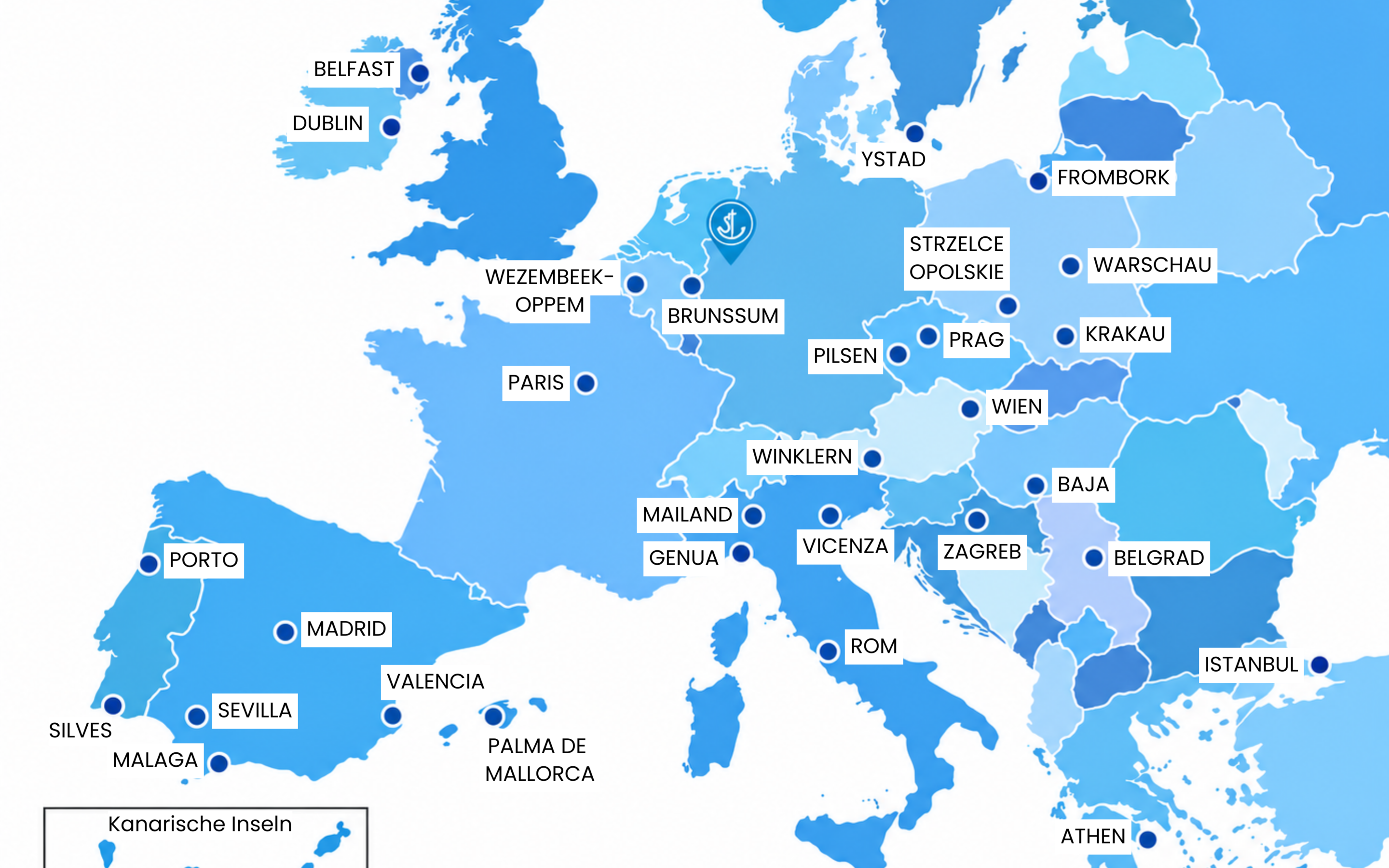
Erasmus+ at the St. Ursula Berufskolleg – What Can Stay, What Needs to Be Changed, and What Are the Benefits for Our Students?
In this article we will describe why the Erasmus sponsorships are important for us as childcare teacher trainees and why we should keep this programme. During the last weeks, we have interviewed other students and had discussions in class talking about our own expectations about going abroad.
Experience Gained by Two Other Students Who Participated in the Erasmus+ Programme as Nursery School Teachers
In class, we prepared a list of interview questions that we found interesting. We then
interviewed two nursery school teacher trainees who had already participated in the Erasmus+ programme and shared their experiences with us.
Our first interviewee decided to take part in an Erasmus exchange as part of her apprenticeship because she enjoys travelling and learning about new cultures, and had already had a positive experience with an exchange before. She spent two months in Italy. Coming from Ecuador, homesickness was nothing new to her, but knowing she would eventually return home made it easier, and she stayed in touch with her mum and boyfriend to cope with it. The most challenging moment during her stay was buying a bus ticket: a misunderstanding with rude staff left her anxious, and she ended up having to pay a €70 fine. Regarding the formalities, she found the application process for the nursery and accommodation fairly easy at first, since she had already submitted many applications before, although waiting for a response was stressful, as rejections were frustrating. Her arrival was difficult mainly because of her heavy suitcases, but overall, careful planning made things go smoothly. She didn’t need any special documents to work in early childhood education in the country she stayed in.
At the international school where she did her internship, she worked with both Italian and American children. Since some Italian children spoke little English, she made sure they felt understood, sometimes using Italian, as it’s similar to Spanish, her native language. She encouraged the children to express themselves through gestures when words weren’t enough, asked questions, and checked in regularly to avoid misunderstandings. She can’t say exactly how early education abroad differs from Germany, but she noticed that the children there seemed more playful and active. Her tasks were similar to those in Germany but adapted to younger children, including supporting teachers, helping with toileting, meals, and planning activities. She also grew professionally by learning to cooperate closely with adult colleagues, since children quickly notice when teamwork isn’t working. Her colleagues were generally open, friendly, and helpful. Looking back, the children gave her a memorable birthday by building her a large cardboard house with a pool and several rooms. Finally, she said she would consider staying longer abroad if it were possible.
Our second interviewee took part in the Erasmus programme because she wanted to discover a new country, get to know a different culture, and experience another education system. She spent eight weeks in Genoa, Italy. During her stay, she did not experience homesickness and said that she did not really miss home. Unfortunately, she had to pay more money than expected for her accommodation.
At the nursery, working with the children was sometimes difficult because some of them did not listen and often screamed. Teacher visits also made the internship more challenging. Regarding the formalities, she found planning her arrival in Italy quite easy. However, finding and booking accommodation was expensive. During her internship, she worked mainly with Italian and German children. Her tasks included preparing brochures and bringing the children to their rooms. Compared to Germany, she noticed that working conditions were different because employees could lose their jobs more easily. Nevertheless, the internship helped her become more self-confident and strengthened her character. One of the highlights of her stay was spending time at the beaches in Italy. She worked about five hours a day, which gave her a lot of free time. She used this opportunity to explore Genoa, visit Milan, and discover more of the country. Looking back, she said that if she had the chance to work abroad again as an early childhood educator, she would spend less time trying to save money and instead invest more in travelling and creating unforgettable experiences. Overall, she described the Erasmus placement as a valuable experience that helped her grow both personally and professionally.
Comparing Working Conditions in Europe and Germany:
Benefits for Nursery School Teachers
On the basis of a working paper on working conditions in Europe (Molinuevo, Ahrendt, Buxbaum, & Moser, 2014), we explored the working conditions of early education jobs in Europe and concluded that they are different across Europe. Comparing these systems can help nursery school teachers see where they might want to work and what could be improved in their own country.
For example, in the Netherlands, working conditions for nursery school teachers were seen as attractive by us. Salaries are relatively high, and better pay makes the job more attractive and helps solve staff shortages. Another important point is the strong focus on training, including digital and video-based training. Dutch nurseries also often use video recordings of nursery school teachers at work to get feedback and improve their skills. This helps teachers to keep learning and stay up to date with new teaching methods (Molinuevo et al., 2014, p. 31).
In Germany, however, there are problems like high workload and staff shortages (Molinuevo et al., 2014, p. 21). Because there are not enough workers, teachers often have to do more work than they should. Some of us compared this to countries like Spain, where teachers have longer holidays, similar to school teachers’ summer breaks (Molinuevo et al.,
2014, p. 33). Because of this, many students think that nursery school teachers in Germany need better working conditions, more free time, and a better work-life balance. This would make the job more attractive and easier to keep doing long-term.
One key idea of all our discussions is that it is useful to learn from other European countries. Teachers who join exchange programmes like Erasmus+ can experience different education systems themselves. This helps them improve their language skills, gain international experience, and understand what it feels like to work abroad. It also helps them think more critically about their own system and notice good ideas through direct experience rather than through theoretical study at school. In conclusion, Erasmus+ gives nursery school teachers the chance to compare working conditions in Europe, improve their skills, and make better decisions about their careers. It also helps spread new ideas that can improve early childhood education, especially in areas like salary, workload, training, and work-life balance.
Should Voluntary Work Be Mandatory for Erasmus+ Participation?
In order to participate in the Erasmus+ programme, students have to provide evidence of previous voluntary work. Making voluntary work mandatory is often seen as problematic, but it also has some benefits like getting to know people from different backgrounds and working with them together as a team. The argument that convinced us the most is personal development. Volunteers can learn new skills, like communication and problem-solving. These skills help them in their personal life and are also important for a nursery school teacher because you work in a team and need communication skills to work with kids and other people (Prokopf, 2018, p. 123). On the other hand, an argument against voluntary work is that people need to go beyond their personal limits (Dorlöchter & Stiller, 2020, p. 242). That’s an important point because not everyone is okay with that. This also affects nursery school teachers because they need a free head and need to keep being calm to work with children. More stress due to extra voluntary work can be bad for them. Overall, the discussion in class resulted in most students being against making voluntary work an obligation for an Erasmus+ participation.
Skills You Gain From Erasmus+
Erasmus+ helps people develop many important skills that are useful in everyday life and in future jobs. We took a closer look at those presented by Abroadship (n.d.), discussed them and identified some we consider most significant for a nursery school teacher. One important skill is cross-cultural communication. During Erasmus+, you learn how to communicate with people from different cultures. You understand other people’s perspectives, learn to listen carefully, adapt to new situations, and express yourself clearly. This is important because nursery school teachers work with children and in a team.
You also develop independence and self-management. Abroad, you no longer have your family close by to help you, so you have to take care of everything in your daily life on your own. You learn how to prioritise your tasks, keep your life in order, and cope with problems as they come up. These skills are important because nursery school teachers have to take care of several children at the same time and often make decisions on their own.
Another important skill is problem-solving and creativity. During Erasmus+, you face new challenges and learn to find creative solutions. You also learn to see difficulties as a chance to grow. With this, teamwork and collaboration can also grow massively. You work with people from different countries and backgrounds. Through group projects or workshops, you learn how to work well with others and achieve common goals.
Erasmus+ also helps you with networking and relationship building. You learn how to meet new people, build friendships, keep in touch over long distances, and become part of international communities. Living in another country also improves global awareness and empathy. You experience different cultures and social challenges and learn respect, understanding, and empathy for other people while becoming more adaptable and resilient. You learn how to deal with language barriers, how to adapt to new situations and see change
as something that helps you grow as a person.
In class, we identified Independence and Self-Management, Teamwork and Collaboration, and Global Awareness and Empathy (Abroadship, n.d.) as the most important skills we could foster through an Erasmus+ participation that help us in our future professions as well.
Final Statement
In the whole article, we wrote about topics like working conditions, skills you gain from Erasmus+, and we did interviews with students that already have experiences with Erasmus+. We learned that it can be difficult and challenging to be alone in a foreign country, but with discipline and motivation, it is still a valuable experience. Erasmus+ is important to our school because it helps students learn essential skills that will serve them well throughout their lives and in their profession as nursery school teachers.
AHR 11 (2025/2026)
References
Abroadship. (n.d.). Top 10 skills you gain from Erasmus+ that schools don’t teach.
https://abroadship.org/top-10-skills-you-gain-from-erasmus-that-schools-dont-teach/
Dorlöchter, H. & Stiller, E. (Eds.). (2020). Phoenix. Der etwas andere Weg zur Pädagogik.
Erziehungswissenschaft in der gymnasialen Oberstufe. Braunschweig: Westermann
Bildungsmedien Verlag GmbH.
Molinuevo, D., Ahrendt, D., Buxbaum, A., & Moser, W. (2014). Early childhood education and care: Working conditions and training opportunities (Report No. EF13101). Eurofound.
https://www.eurofound.europa.eu/en/publications/all/early-childhood-education-andcare-working-conditions-and-training-opportunities
Prokopf, A. (2018). Social commitment: Voluntary, obligatory? A theological view on the
freedom of a Christian. Multidisciplinary Journal of School Education, 14(2), 121-141.
https://doi.org/10.14632/mjse.2018.14.121
Neueste Artikel
Erasmus+ at the St. Ursula Berufskolleg – What Can Stay, What Needs to Be Changed, and What Are the Benefits for Our Students?
In this article we will describe why the Erasmus sponsorships are important for us as childcare teacher trainees and why we should keep this programme. During the last weeks, we have interviewed other students and had discussions in class talking about our own expectations about going abroad.
Abiturpreis 2026
Vom St. Ursula-Berufskolleg waren bei der Ehrung dabei: Johanna Stecher (8. v.r.) und Malena Straßberger (7.v.r.), Religionslehrer Peter Gerding (3. v.r.) und Schulleiter Michael Roth (r.)
Mittwoch, 16. September: Nachhaltigkeitsrallye
17 SDGs, 17 Stationen und viele neue Impulse